AK-47
Also known as AK, Avtomat Kalashnikova, Kalashnikov, Type 3 AK
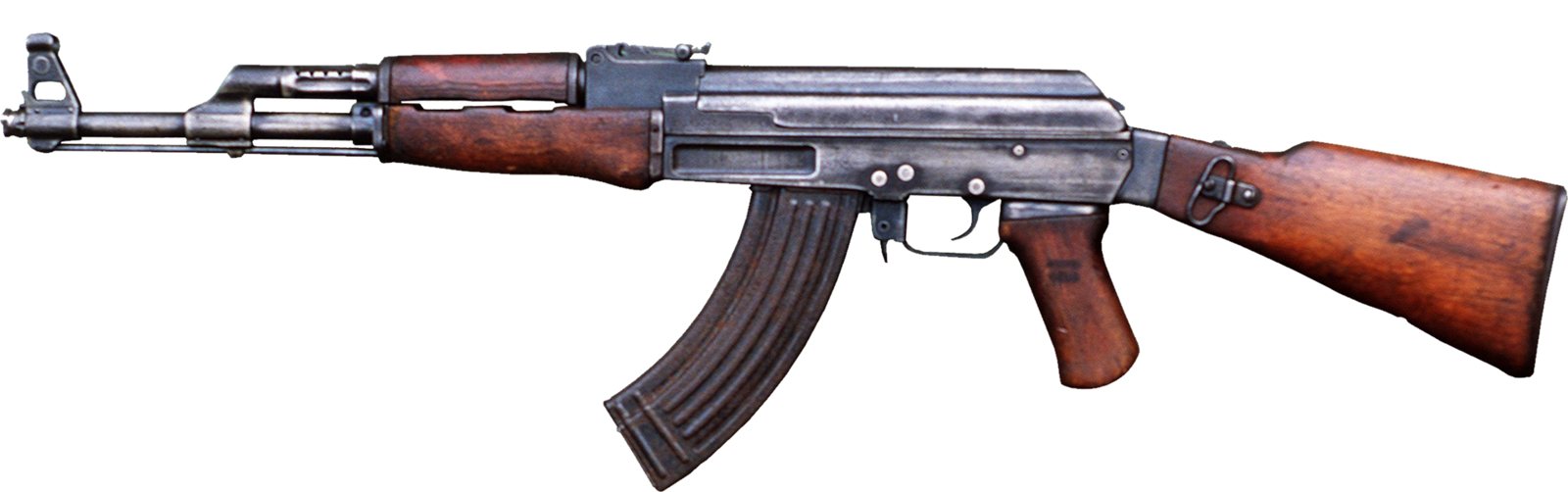
Specifications
| Spec | AK (1949) | AKM |
|---|---|---|
| Cartridge | 7.62×39mm (M43)[2][3] | |
| Action | Gas-operated, long-stroke piston, two-lug rotating bolt[3] | |
| Fire modes | Semi-auto and full auto (military); semi-auto only (civilian copies)[3][28] | |
| Overall length | 34.3 in (870 mm)[3] | 34.6 in (880 mm); AKMS 25.2 in (640 mm) folded[4] |
| Barrel length | 16.3 in (415 mm)[3][4] | |
| Weight, empty | 9.5 lb (4.3 kg) early milled; 8.4 lb (3.8 kg) lightened Type 3[2][3] | 7.3 lb (3.3 kg)[4] |
| Magazine | 30-round detachable box[3][4] | |
| Cyclic rate | About 600 rounds per minute[3][4] | |
| Rear sight | Tangent leaf, 100–800 m[2][3] | — |
| Bullet and velocity (57-N-231 ball) | About 120–124 gr (7.75–8.05 g) steel-core bullet at 2,330–2,380 ft/s (710–725 m/s)[2] | |
History
Mikhail Kalashnikov joined the Red Army in 1938 and worked on tanks before a wartime wound…
From tanks to rifles
Mikhail Kalashnikov joined the Red Army in 1938 and worked on tanks before a wartime wound pushed him toward small arms. His first designs, a submachine gun and a light machine gun, were turned down, but artillery expert General A. A. Blagonravov encouraged him to keep going.[5][7]
A new cartridge sets the stage
In mid-1943, after studying the captured German MKb.42(H) and the American M1 carbine, Soviet planners ordered an intermediate cartridge and a family of weapons to fire it. The first version, the M43, used a 41 mm case. Around 1945–46 the case was trimmed to 39 mm and the bullet changed to a boat-tailed, steel-core design: the 7.62×39mm round every AK fires.[2][3]
Winning the 1946–47 trials
Designers entered the 1946 rifle competition under code names; Kalashnikov's was "Mikhtim", from Mikhail Timofeyevich. His AK-46 did not win outright. In Kovrov he and engineer Alexander Zaitsev reworked it heavily, borrowing ideas from rival designs: Bulkin's stamped receiver with a removable cover and a bolt carrier with the piston built in, a trigger based on the Czech ZH-29, and a safety/selector lever inspired by the Remington Model 8.[2][3][7]
Three of the new AK-47s were built in November 1947. In trials from 16 December 1947 to 11 January 1948 the better rifle had 8 stoppages in 15,000 shots; Bulkin's and Dementiev's rifles fell short. On 21 January 1948 the Soviets ordered a first batch of 1,500.[2]
Adopted in 1949 as the "AK"
The Soviet Army formally adopted the rifle on 18 June 1949, together with the SKS carbine and the RPD light machine gun. Its service name was simply AK, the 7.62 mm Kalashnikov automatic rifle; "AK-47" was the prototype's name, which the West later applied to the whole family.[1][6][23]
Production went to Izhevsk. The first receivers were stamped sheet steel, and the factory rejected too many of them. By the end of 1949 a receiver machined from a forging was judged the cheaper route, and mass production of that version began in 1951.[2][3][8]
Lighter rifles: the 1955 AK and the AKM
A lightened milled receiver arrived in 1955, about 0.5 kg (1.1 lb) lighter than before, along with thinner ribbed magazines and a knife bayonet. Collectors call it the Type 3.[2][3]
The Army wanted lighter and cheaper still. Requirements went out in 1953, trials ran in 1956–57, and on 8 April 1959 the Soviets adopted the AKM, a modernized AK with a stamped receiver that weighed about 1 kg (2.2 lb) less. The folding-stock AKMS followed in 1962.[2][4][10]
Around the world
The Soviet Union exported AKMs and handed full production know-how to its allies. China received the technical package in the 1950s and built tens of millions of Type 56 rifles. Bulgaria began licensed production at Kazanlak in 1958, and Hungary, Poland, East Germany and Romania followed.[1][4][11][15][28]
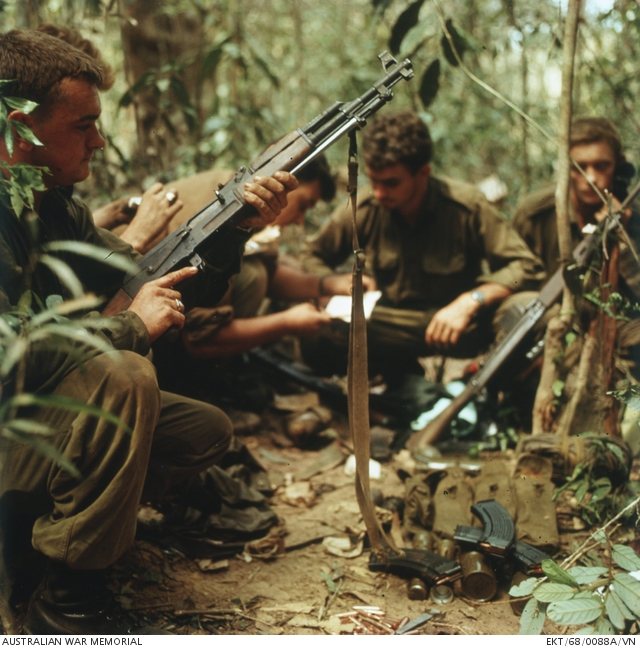
The West saw the rifle in action early. During the 1956 Hungarian Revolution, insurgents captured AKs from Soviet troops.[27] In Vietnam, American Captain Gregory P. Dillon captured a 1953 Soviet AK at Bong Son in 1966 and carved his name into the stock; the Royal Armouries acquired it in 2005 and tracked him down in 2012.[26]
Successors and legacy
The Soviets moved to the smaller 5.45×39mm cartridge with the AK-74, adopted on 18 January 1974; Russia's current service rifle, the AK-12, was adopted in 2018.[2][14] By 2007 estimates put the number of Kalashnikov-type rifles at 50 to 100 million, in the arsenals of more than 80 countries.[22][23]
C. J. Chivers, reporting from Afghanistan, still found Kalashnikovs made in the 1950s in use more than half a century later.[24] In May 1990 Kalashnikov met his American counterpart, M16 designer Eugene Stoner, at Star Tannery, Virginia, for a Smithsonian video history.[5]
How it works
The AK is a gas-operated rifle with a long-stroke piston mounted above the barrel.
The AK is a gas-operated rifle with a long-stroke piston mounted above the barrel. When a round fires, some of the propellant gas is tapped from the barrel into the gas tube. It drives a piston rod that is permanently attached to a massive bolt carrier, so the whole assembly travels back together. The carrier turns the two-lug bolt to unlock it from the trunnion, the empty case is pulled out and thrown clear, and the return spring drives everything forward to chamber the next round and lock up again.[3][28]
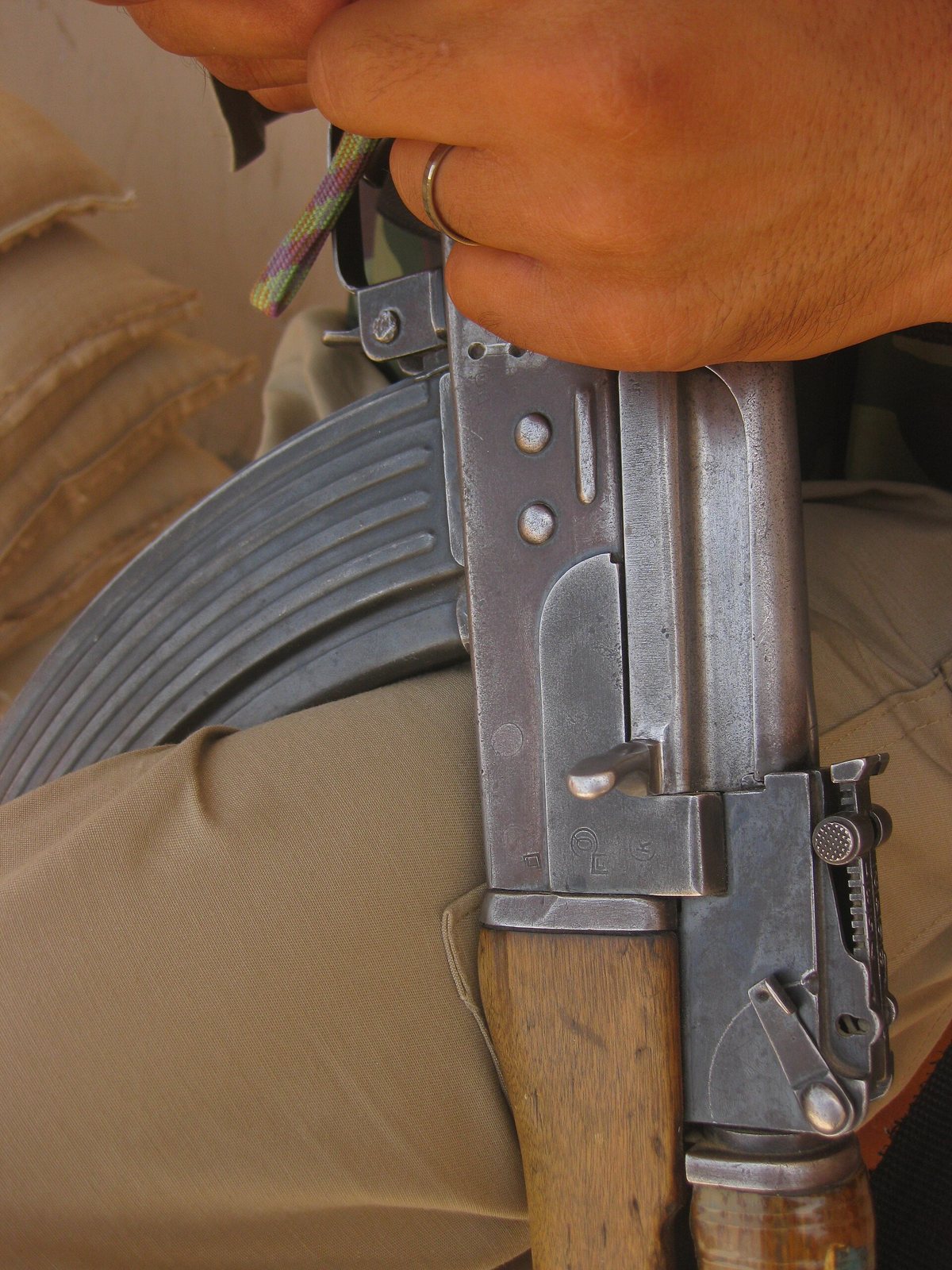
That simple, heavy action is the core of the rifle's reputation. In a 2024 test of a Romanian WASR-10, the rifle cycled every type of ammunition used, from three different makers, without a problem.[28] Controls are simple: the charging handle is fixed to the right side of the carrier, and one large lever on the right acts as safety and fire selector. On safe it covers the charging-handle slot and stops the bolt from moving far enough to chamber or extract a round.[3] The original rear sight was a notch adjustable from 100 to 800 m, and the first rifles had no bayonet lug.[3]
The 7.62×39mm cartridge
Every AK and AKM fires the 7.62×39mm round, born as the Soviet M43 in 1943.
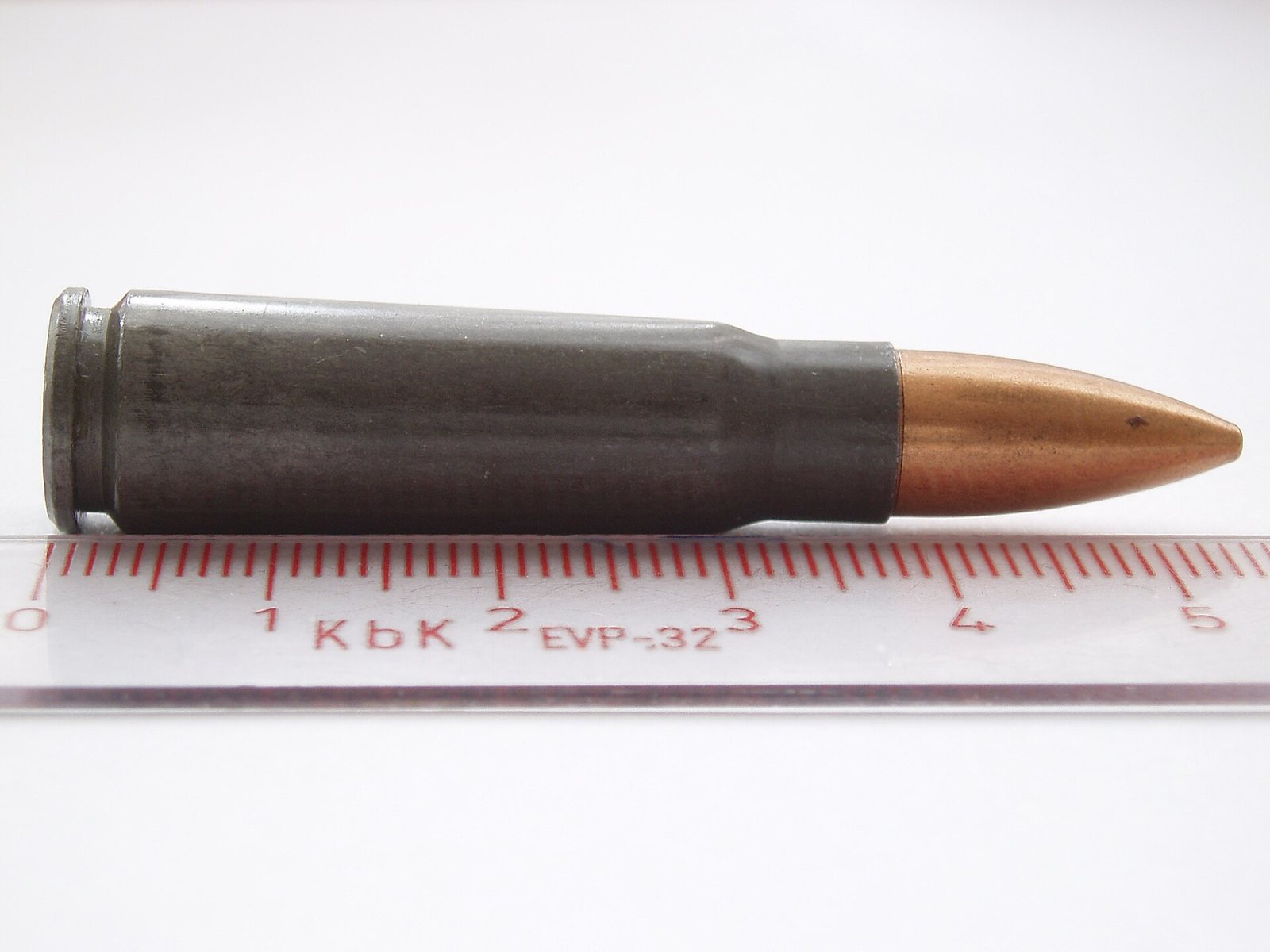
Every AK and AKM fires the 7.62×39mm round, born as the Soviet M43 in 1943. Its case started at 41 mm and was trimmed to 39 mm around 1945–46, when the bullet also switched to a boat-tailed, steel-core design.[2][3] The standard Soviet 57-N-231 ball round pushes a bullet of about 120–124 gr (7.75–8.05 g) at roughly 2,330–2,380 ft/s (710–725 m/s), and the Soviets moved to lacquered steel cases in 1956.[2]
The later AK-74 family uses the smaller 5.45×39mm round, so the two do not interchange.[23] Common US loads today are 123-grain soft points, hollow points and steel-cased FMJ.[28]
7.62x39 ammoMSRP per round: median $1.30See 7.62x39 loads →Variants and how to identify them
8 models: AK "Type 1", AK "Type 2", AK "Type 3", AKS…
| Model | Years | Key differences | How to identify |
|---|---|---|---|
| AK "Type 1" (stamped receiver)NFA machine gun Izhevsk | 1949–1951 |
| Stamped receiver with separate riveted trunnions, two separate grip panels, and a short compensator formed as part of the front sight base. Russian manuals simply called it early production; Type 1, 2 and 3 are Western collector labels.[2][3] |
| AK "Type 2" (milled receiver)NFA machine gun Izhevsk | 1951–1955 (some sources: to 1957) |
| Machined receiver with a long rectangular lightening cut above the magazine well; the cut runs parallel to the top of the receiver. The buttstock fits into a steel socket at the rear of the receiver.[1][3][9] |
| AK "Type 3" (lightened milled receiver)NFA machine gun Izhevsk, licensed factories abroad | 1955–1959 |
| Milled receiver whose lightening cut runs parallel to the bottom of the receiver, directly above the magazine well, plus a sling loop on the gas block.[3][9] |
| AKSNFA machine gun Izhevsk | 1949–1959 |
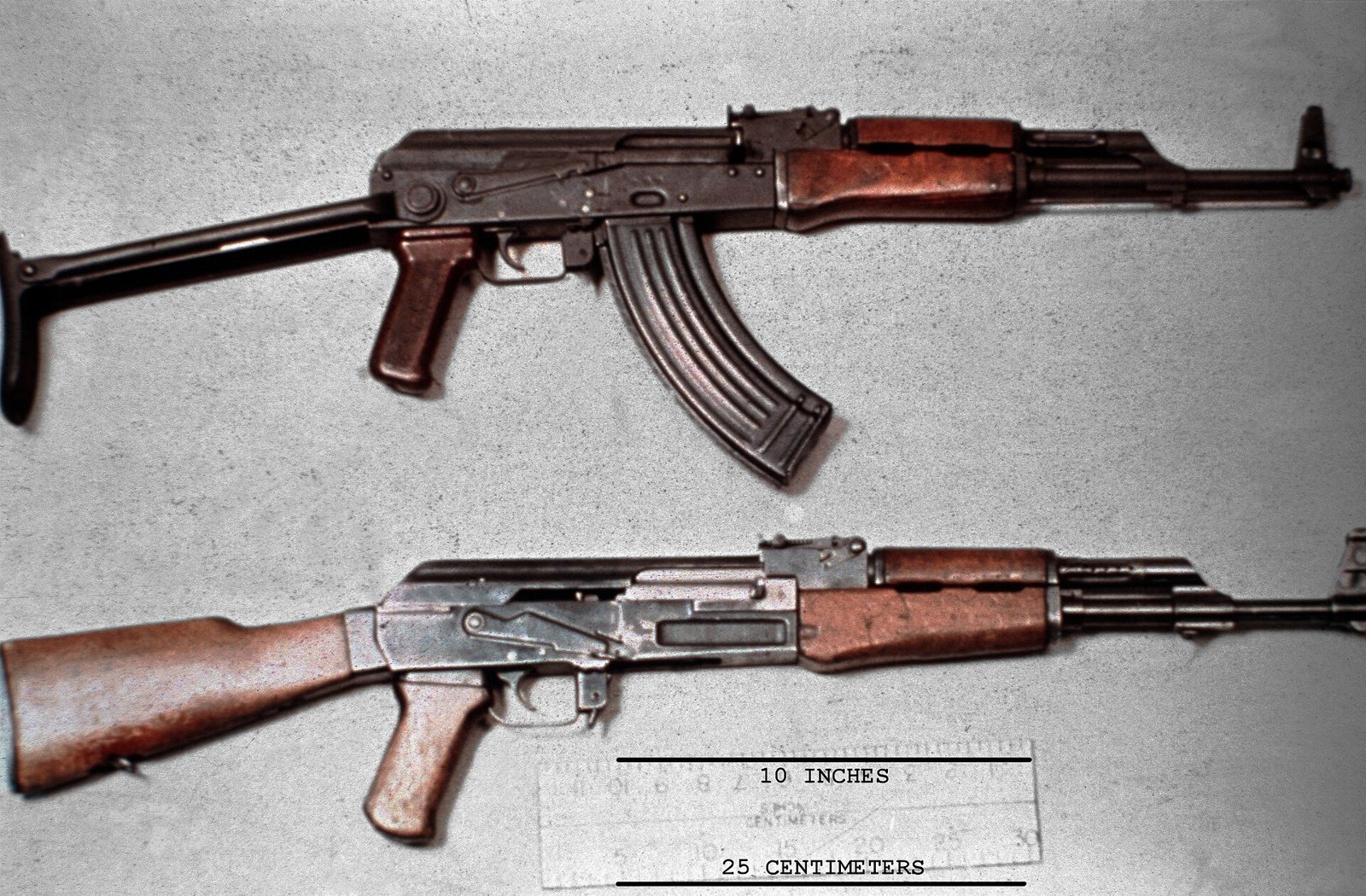
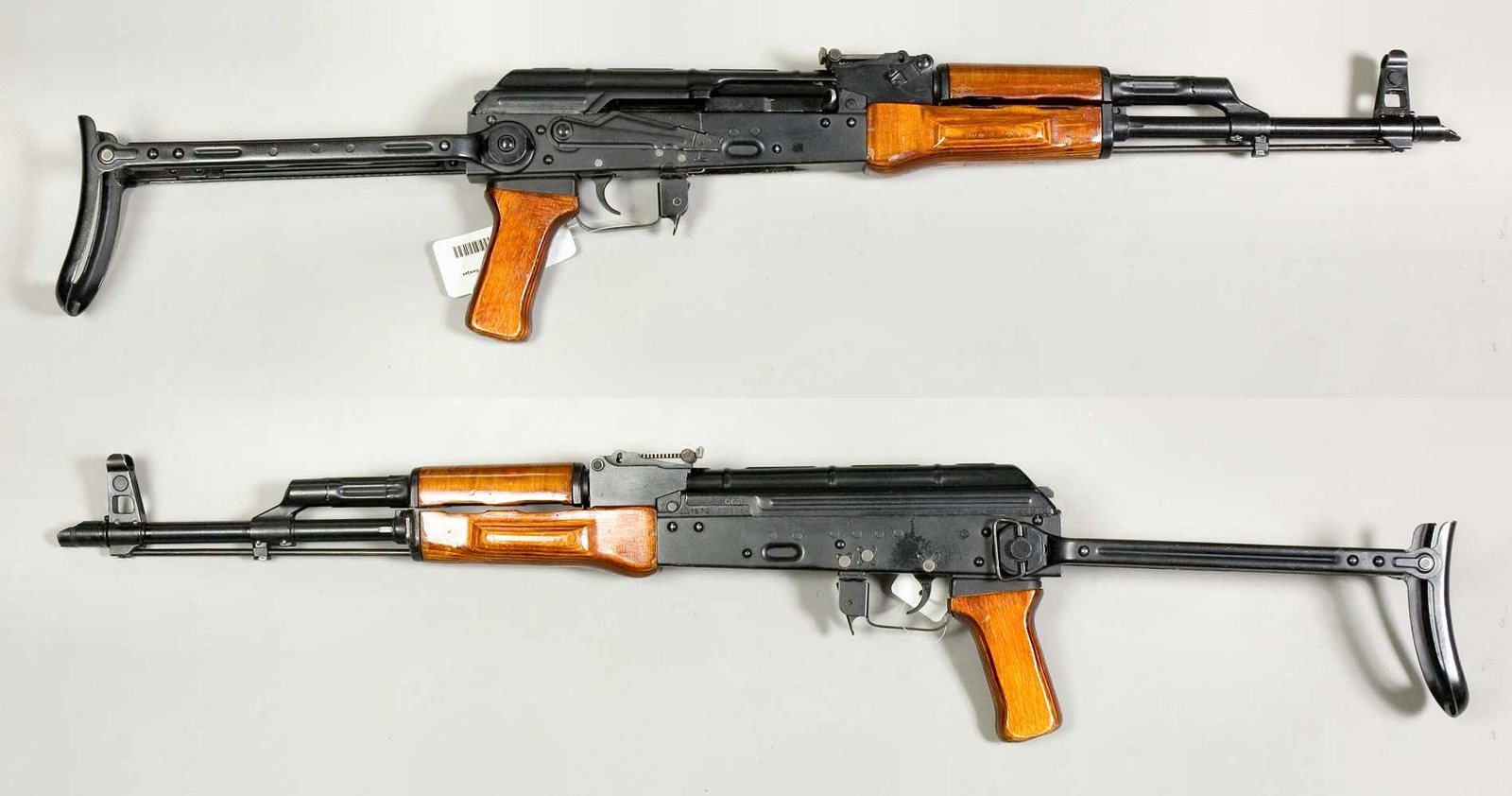
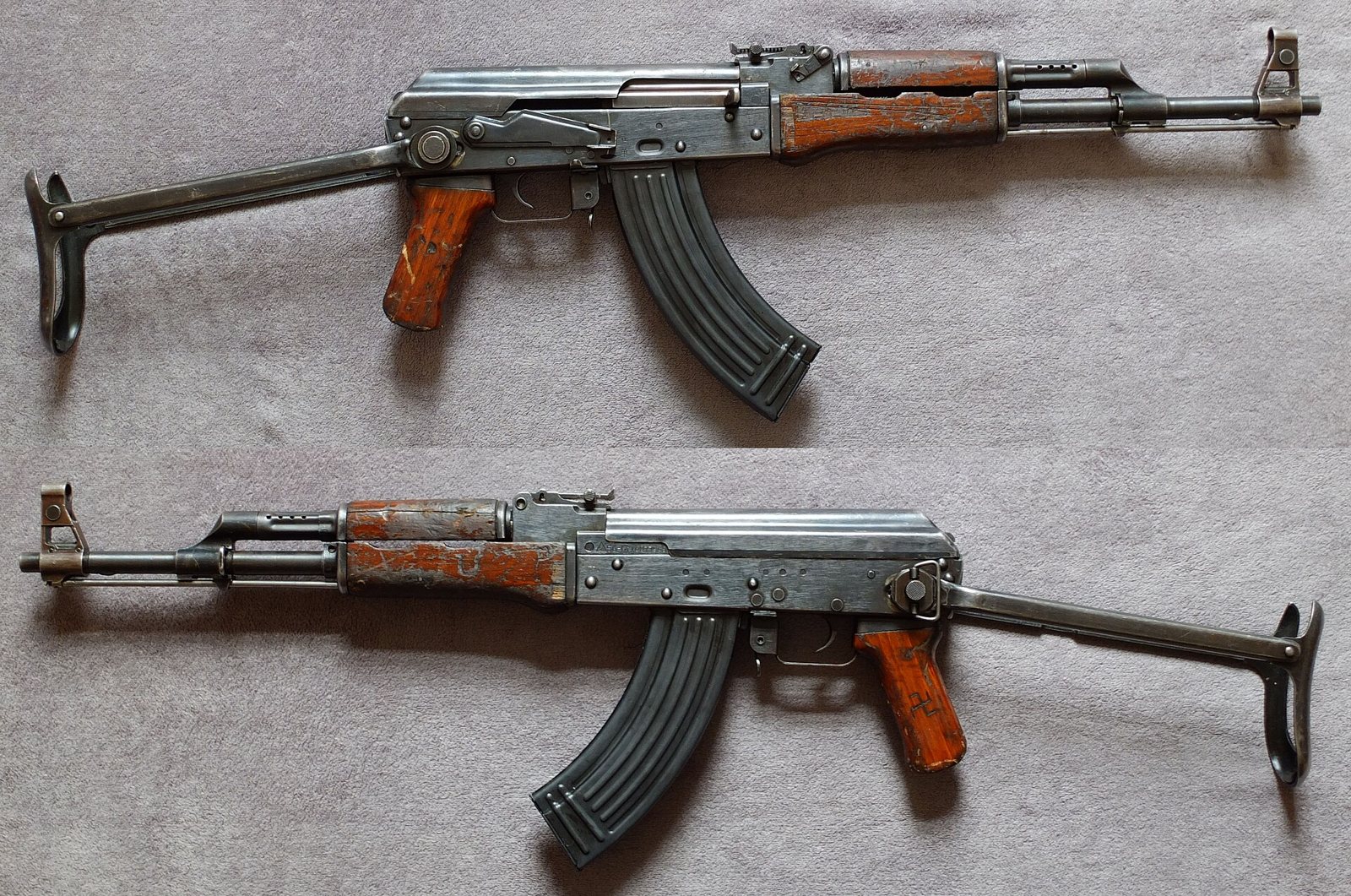
| A milled AK with a steel underfolding stock instead of a wooden buttstock.[1][3] |
| AKMNFA machine gun Izhevsk, Tula, licensed in Bulgaria, East Germany, Hungary, Poland, Romania and others | 1959–1977 (Soviet production) |
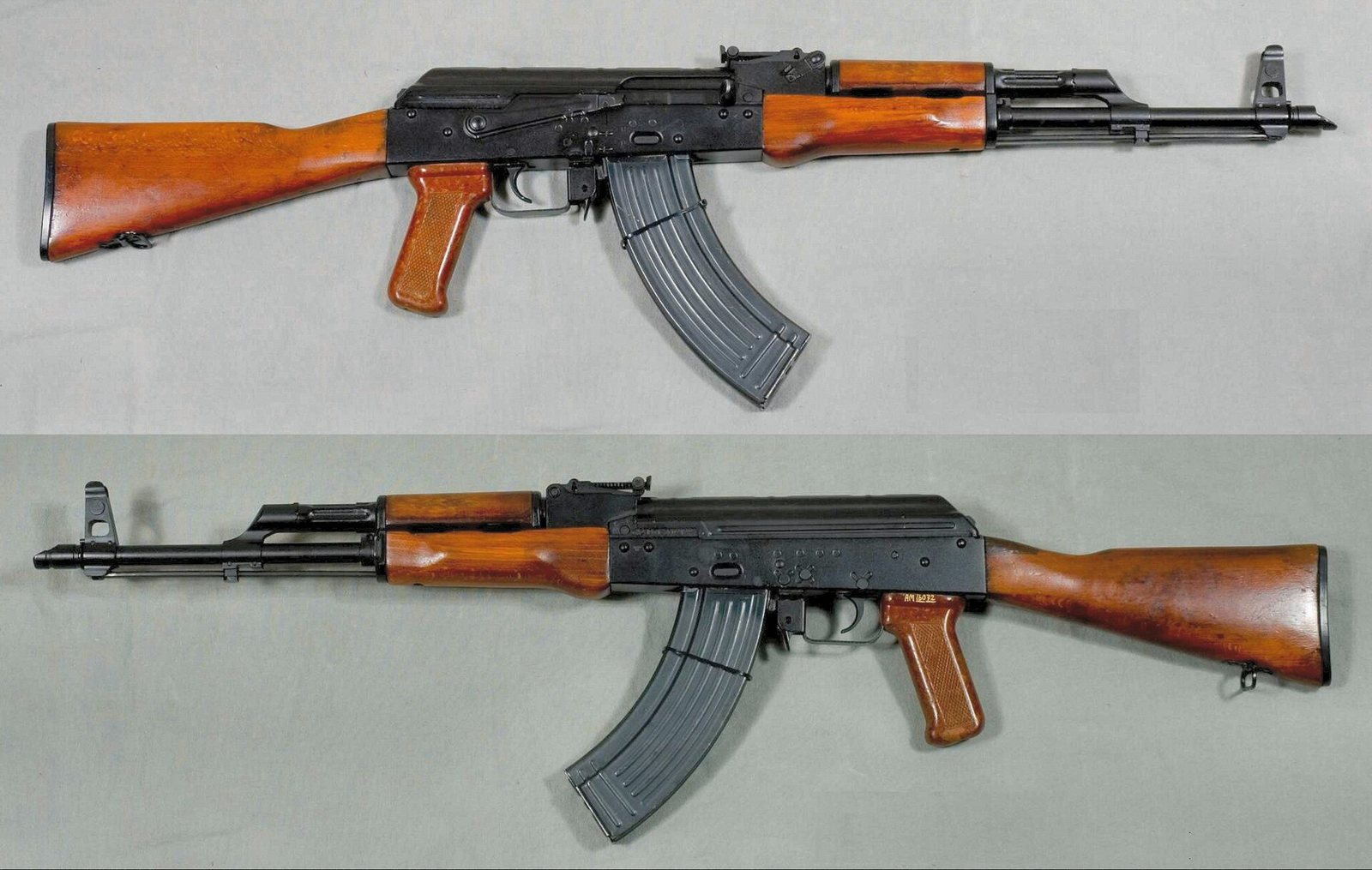
| Stamped receiver with a small dimple above the magazine well (instead of a long milled cut), rivets along the receiver, a ribbed top cover and, on most rifles, a slanted muzzle compensator.[1][2][4] |
| AKMSNFA machine gun Izhevsk, Tula | 1962–1977 |
| Stamped AKM receiver with dimple, plus an underfolding stock with stamped struts.[1][2] |
| Type 56 (China)NFA machine gun Norinco and other Chinese state factories | 1956–early 1980s in service production |
| AK profile with a folding spike bayonet under the barrel and Chinese factory markings; early rifles are milled, later ones stamped.[11][12] |
| AKM-pattern semi-auto rifles (civilian)Semi-auto Cugir/Century Arms (Romania), Zastava (Serbia), Arsenal (Bulgaria), US makers | 1990s–present (US market) |
| Semi-auto fire control with no full-auto setting. The WASR-10 skips the AKM dimple and uses welded internal brackets instead.[28] |
Receiver types: Type 1, 2 and 3
Collectors sort the original AK by receiver.
Collectors sort the original AK by receiver. The labels are Western; Soviet manuals did not use them.[2]
- Type 1 (1949–51): stamped sheet-steel receiver. Too many were rejected at the factory.[3][8]
- Type 2 (from 1951): receiver machined from a forging, with a steel socket for the buttstock.[3][9]
- Type 3 (1955–59): lightened milled receiver, about 0.5 kg (1.1 lb) lighter, with the lightening cut running right above the magazine well. The most copied milled AK.[2][9]
Sources differ on credit for the milled receiver: Forgotten Weapons names a team led by Valeriy Kharkov, while Popenker credits Kalashnikov. They also differ on when Type 2 production ended (1954–55 or 1957).[2][3][9]
Family tree
14 related models, at home and abroad
Where the AK-47 came from and the rifles it led to, at home and abroad.
- Started as: AK-46 prototype (1946) — Kalashnikov's first trials rifle; reworked into the AK-47 in 1947.[3]
- Influenced by: Bulkin AB-46 rifle — Stamped receiver with removable cover; carrier with built-in piston.[2][3]
- Influenced by: Sturmgewehr / MKb.42(H) concept — Intermediate-cartridge idea only; the AK is not a copy of a German rifle.[3][25]
- Look-alike, not a relative: Sa vz.58 (Czechoslovakia) — Looks like an AK but is mechanically unrelated.[21]
AK-47 vs AKM: how to tell them apart
16 differences, side by side
| Feature | AK ("AK-47") | AKM |
|---|---|---|
| Adopted[6][10] | 18 June 1949 | 8 April 1959 |
| Receiver[3][4] | Machined from a forging (stamped on early Type 1 rifles) | Stamped steel, riveted |
| Above the magazine well[1] | Long rectangular lightening cut | Small dimple |
| Top cover[4] | Smooth | Ribbed for strength |
| Muzzle[1][4] | No slant compensator | Slant compensator, standard from 1965 |
| Barrel fitting[3][4] | Screwed into the trunnion and pinned | Pressed into the trunnion and pinned |
| Trigger group[4] | No rate reducer | Hammer delay (rate reducer) added |
| Weight, empty[2][3][4] | 9.5 lb (4.3 kg); 8.4 lb (3.8 kg) for Type 3 | 7.3 lb (3.3 kg) |
| Bayonet[2][3] | None on early rifles; knife bayonet from 1955 | Bayonet lug standard |
| Folding-stock version[1][4] | AKS | AKMS (1962) |
| Soviet production[2][3] | 1949–1959; total unknown | 1959–1977; about 10 million |
Most semi-auto "AK-47" rifles sold in the US are AKM pattern. Some, like the WASR-10, skip the dimple and use internal brackets instead.[28]
| Feature | Type 1 | Type 2 | Type 3 |
|---|---|---|---|
| Years[2][3][9] | 1949–1951 | 1951–1955 (or 1957) | 1955–1959 |
| Receiver[3][9] | Stamped sheet steel | Machined from a forging | Machined, lightened |
| Lightening cut[9] | n/a | Parallel to the top of the receiver | Parallel to the bottom, right above the magazine well |
| Stock attachment[3][9] | No separate socket | Steel socket pinned to the receiver | Steel socket |
| Weight, empty[2][3][9] | About 1 lb lighter than Type 2 | About 4.3 kg (9.5 lb) | About 3.8 kg (8.4 lb) |
Type numbers are Western collector labels. Sources differ on when Type 2 production ended.[2][9]
Who used it
12 countries and forces: Soviet Union, China, Bulgaria…
| Country | Who and what | Years |
|---|---|---|
| Soviet Union | Soviet Army: standard rifle, replaced in production by the AKM from 1959[6][10] | From 1949 |
| China | People's Liberation Army (Type 56)[11][12] | 1956–early 1980s |
| Bulgaria | Licensed production at Arsenal, Kazanlak[15] | 1958– |
| Hungary | Licensed AKM copy (AKM-63)[16] | 1963– |
| Poland and East Germany | Licensed AKM production[4] | — |
| Romania | PM md. 63, licensed AKM copy made at Cugir[28] | 1963– |
| Yugoslavia / Serbia | Zastava M70 family; Army and police, widely exported[17] | 1970s–present |
| Finland | Valmet Rk.62, licensed derivative[18] | From the 1960s |
| Israel | Galil, derived from the Valmet[19] | 1973– |
| Iraq | Tabuk, licensed copy of the Zastava M70[17] | — |
| Vietnam War | Used against US forces; a 1953 Soviet AK captured in 1966 is now in the Royal Armouries[26] | 1960s |
| Russia | AK-74M, then AK-12 (adopted 2018)[1][14] | 1991–present |
How many were made
Original AK: unknown.
Nobody has a reliable total for the original 1949–59 AK. Later models are better documented: the Soviet Union built about 10 million AKMs and AKMSs, with Izhevsk peaking at 563,000 rifles in 1974, and more than 5 million 5.45mm AK-74-family rifles between 1974 and 1993.[2][4]
Abroad, China made tens of millions of Type 56 rifles and Bulgaria's Arsenal passed 1 million by 1982.[11][15] For the whole Kalashnikov family, the best estimates are 50 to 100 million, more than any other firearm design.[1][22][23]
Sources differ: Saferworld (2007) estimates 50–70 million Kalashnikovs, the Small Arms Survey (2007) 50–100 million.[22][23]
Timeline
- 1942Kalashnikov begins designing small arms after being wounded.[5][7]
- 1943Soviet program for an intermediate cartridge (M43) and new weapons begins.[3]
- 1946Kalashnikov enters the rifle trials as "Mikhtim" with the AK-46.[3][7]
- 1947Redesigned AK-47 wins the December trials at Kovrov.[2][3]
- 1948Order for a first batch of 1,500 rifles (21 January); field trials.[2]
- 1949Adopted on 18 June as the AK, alongside the SKS and RPD.[6]
- 1951Mass production of the milled-receiver AK ("Type 2") begins.[2][9]
- 1955Lightened milled AK ("Type 3") enters production.[2][3]
- 1956China adopts the Type 56; Hungarian insurgents capture Soviet AKs.[12][27]
- 1958Bulgaria's Arsenal factory at Kazanlak builds its first licensed rifles.[15]
- 1959The AKM is adopted on 8 April and replaces the AK in production.[4][10]
- 1962Folding-stock AKMS adopted.[2][4]
- 1974AK-74 in 5.45×39mm adopted on 18 January.[2]
- 1977Soviet AKM production ends after about 10 million rifles.[2]
- 1989The US suspends, then bans, imports of AK-type semi-automatic rifles.[30]
- 1990Kalashnikov meets Eugene Stoner in Virginia (May); 922(r) parts rule enacted.[5][31]
- 1997Romania's Romarm signs its first contract with Century Arms, start of the WASR era.[29]
- 2014US Treasury sanctions Russia's Kalashnikov Concern (16 July).[38]
- 2018Russia adopts the AK-12.[14]
Myth: Hugo Schmeisser designed the AK
The AK is not a copy of the German StG 44, and Hugo Schmeisser did not design it.
The AK is not a copy of the German StG 44, and Hugo Schmeisser did not design it. Schmeisser was one of about 15 German engineers held at Izhevsk from 1946 to 1951, but the AK was designed in Kovrov, the Germans were kept away from secret projects, and Schmeisser reportedly refused design work.[2][3]
What the Soviets did take from the Germans was the idea: an intermediate cartridge and a rifle built around it. C. J. Chivers calls the AK a conceptual knockoff, not a mechanical one.[3][25] The Czech vz.58 is the reverse case: it looks like an AK but is mechanically unrelated.[21]
Legacy
No other firearm design has been built in such numbers.
No other firearm design has been built in such numbers. Estimates for the whole Kalashnikov family run from 50 to 100 million, far ahead of the G3 (15–20 million) and the M16 (5–7 million).[22][23] Nearly 200 distinct AK-type copies and variants have been identified, made in dozens of countries.[1]
The basic layout also lived on in other rifles: Finland's Valmet Rk.62 refined the milled AK, Israel's Galil was based on the Valmet, and Russia still fields Kalashnikov-pattern rifles in the AK-12.[14][18][19] In the US the AKM pattern, in semi-automatic form, has been a fixture of the civilian rifle market since the mid-1990s.[28]
Owning an AK in the US
A real AK-47 or AKM fires full auto, which makes it a machine gun under the National Firearms…
A real AK-47 or AKM fires full auto, which makes it a machine gun under the National Firearms Act.[33] Civilians can own one only if it was lawfully registered before 19 May 1986; it must be listed in the national registry, and each transfer needs ATF approval and a $200 tax.[31][34][35][36] That limits original select-fire AKs to a small, expensive collector market.
The AK-pattern rifles in gun stores are semi-automatic, which keeps them outside the NFA machine-gun definition, so under federal law they are sold like other rifles.[33]
- 1989: ATF suspended imports of AKS-type rifles on 14 March 1989, then found in July that military-style semi-autos were not "sporting" and could not be imported under 18 U.S.C. 925(d)(3).[30]
- 1990: Congress added 922(r), which bars building a banned-for-import semi-auto from imported parts. Under 27 CFR 478.39, a rifle may contain no more than 10 of the listed imported parts.[31][32]
- Because of this, importers ship rifles in import-legal form and then fit US-made parts, such as triggers, pistons and magazines, before sale.[28][29]
- 1994–2004: a federal assault weapons ban restricted many semi-automatic rifles and magazines until it expired in 2004.[31]
- 2014: the US Treasury placed Russia's Kalashnikov Concern under sanctions.[38]
- States can go further. California, for example, lists all AK-series rifles as assault weapons.[37]
This summarizes federal law and one state example. It is not legal advice; check your state and local laws before you buy.
Shop this model
If you want an AK today, you are almost always buying a semi-automatic AKM-pattern rifle in 7.62×39mm. Factory imports such as Romania's WASR-10 are built at original arsenals, while other rifles are assembled in the US.[28] Arsenal's Bulgarian-made rifles stand out for keeping the milled receiver.[15]
Check the cartridge before you buy: AK-74-pattern rifles fire 5.45×39mm, not 7.62×39mm.[23] And a vz.58 only looks like an AK; inside, it is an entirely different design.[21]
- CenturyCentury Arms GP WASR10 AK-47 Rifle 7.62x39 CAL. 1-30 Rounds MagRomanian-made, AKM pattern$1,070.00 MSRPView product →
- Zastava Arms USAZastava ZPAPM70 7.62x39MM 30 Rounds Blued Walnut FurnitureSerbian-made, walnut stock$1,337.99 MSRPView product →
- ArsenalArsenal SAM7SF-84E 7.62x39 Rifle 1-10 Rounds Mag BlackBulgarian-made, milled receiver$1,999.99 MSRPView product →
- Zastava Arms USAZastava ZPAPM70 Retro 7.62x39 30 Rounds Blued Beech FurnitureSerbian-made, beech stock$1,367.99 MSRPView product →
- CenturyCentury Arms BFT47 AK Rifle 7.62x39 Wood FurnitureWood furniture$830.00 MSRPView product →
- Riley DefenseRiley Defense RAK47 Classic 7.62x39MM 30 Rounds Matte/WoodWood furniture$929.00 MSRPView product →
- ArsenalArsenal SAM7UF-85 7.62x39 Rifle w/1-10 Rounds MagazineBulgarian-made underfolder$2,000.00 MSRPView product →
- Zastava Arms USAZastava ZPAPM70 7.62x39MM 16.5" Black Under FolderSerbian-made underfolder$1,666.99 MSRPView product →
- CenturyCentury Arms Underfolder AK47 7.62x39 30 Rounds MagUnderfolding stock$1,156.00 MSRPView product →
- CenturyCI Vska Stamped AK-47 Rifle 7.62x39 CAL. Wood StockStamped receiver, wood stock$799.00 MSRPView product →
- ArsenalArsenal SAM7R-62 7.62x39 Rifle w/1-10 Rounds MagazineBulgarian-made, milled receiver$1,929.99 MSRPView product →
- Pioneer ArmsPioneer Arms AK-47 Sporter 7.62x39 16.5" Laminated STKLaminated stock$785.00 MSRPView product →
- Pioneer ArmsPioneer Arms AK-47 Sporter 7.62x39 16.5" 1-30 Rounds Synthetic BlackSynthetic stock$785.00 MSRPView product →
- Black Rain OrdnanceBlack Rain Freedom Fighter AK47 7.62x39 Black 30 RoundsBlack synthetic furniture$2,789.00 MSRPView product →
Retailer prices coming soon. We're adding stores now. Prices shown are MSRP (manufacturer's suggested retail), not deal prices. See all 7.62x39 rifles in the catalog →
7.62x39 ammoMSRP per round: median $1.30See 7.62x39 loads →Collecting and identification
Collectors value rifles and parts made in the original military arsenals, such as Izhevsk in…
Collectors value rifles and parts made in the original military arsenals, such as Izhevsk in Russia, Cugir in Romania, Kazanlak in Bulgaria and Radom in Poland, over rifles assembled from mixed parts kits.[28] Bulgarian Arsenal rifles carry the factory's number 10 inside a circle.[15] Start by checking the receiver: a long milled cut above the magazine well means a milled AK pattern, while a small dimple means a stamped AKM pattern.[1]
Some AKs carry a story. The Royal Armouries' Dillon AK, a 1953 Soviet rifle, still bears the name its captor carved into the stock in Vietnam in 1966.[26]
Frequently asked questions
What is the difference between an AK-47 and an AKM?
The AKM is the modernized AK adopted in 1959. It swapped the milled receiver for a stamped steel one, which cut about 1 kg (2.2 lb), and added a ribbed top cover, a rate reducer and, from 1965, a slanted muzzle compensator. The quickest tell is above the magazine well: a long milled cut means AK, a small dimple means AKM.[1][4][10]
Was the AK-47 adopted in 1947?
No. The name comes from the 1947 prototype that won the Soviet trials in December 1947. After field trials in 1948, the Soviet Army formally adopted the rifle on 18 June 1949, along with the SKS carbine and the RPD machine gun. Its official name was simply AK.[2][3][6]
Did Hugo Schmeisser design the AK-47? Is it a copy of the StG 44?
No. Schmeisser was one of about 15 German engineers held at Izhevsk from 1946 to 1951, but the AK was designed in Kovrov, and the Germans were kept away from secret work. The Soviets borrowed the German idea of an intermediate-cartridge rifle, not the StG 44's mechanism.[2][3][25]
What caliber does the AK-47 shoot, and what are its range and rate of fire?
It fires 7.62×39mm. The standard Soviet ball round leaves the barrel at about 2,330–2,380 ft/s (710–725 m/s). The original rear sight is graduated from 100 to 800 meters, and the cyclic rate on full auto is about 600 rounds per minute. Magazines hold 30 rounds.[2][3]
Is it legal to own an AK-47 in the US?
A select-fire AK is a machine gun under the NFA. Civilians can own one only if it was registered before 19 May 1986, and each transfer needs ATF approval and a $200 tax. Semi-automatic AK-pattern rifles fall outside that definition and are sold like other rifles under federal law, but some states, such as California, ban them. This is not legal advice.[31][33][34][37]
How many AK-47s have been made?
No one knows how many original 1949–59 AKs were built. The Soviet Union made about 10 million AKMs, and estimates for the whole Kalashnikov family, including foreign copies and the AK-74 line, run from 50 to 100 million. That makes it the most produced firearm design in history.[1][2][22][23]
Milled or stamped receiver: what is the difference?
A milled receiver is machined from a solid steel forging; the AK used one from 1951 to 1959. A stamped receiver is pressed from sheet steel and riveted; the AKM adopted that in 1959 to save weight and cost. Most modern AKs are stamped, while Bulgaria's Arsenal is known for staying with milled receivers.[3][4][10][15]
What are Type 1, Type 2 and Type 3 AKs?
They are Western collector labels for the three receivers used on the original AK. Type 1 (1949–51) is stamped, Type 2 (from 1951) is machined from a forging, and Type 3 (1955–59) is a lightened milled receiver that weighs about 0.5 kg less. Soviet manuals never used these names.[2][8][9]
Why do imported AKs have US-made parts?
Since 1989, military-style semi-automatic rifles can't be imported as "sporting" guns. Federal rule 922(r) then bars building such a rifle from too many imported parts, with no more than 10 of the listed parts allowed. So importers bring rifles in import-legal form and add US-made parts such as triggers, pistons and magazines.[29][30][31][32]
Gallery
8 photos with credits
All photos come from Wikimedia Commons and are used under the license shown with each one.
Sources
38 numbered sources
- Jonathan Ferguson and N. R. Jenzen-Jones. An Introduction to Basic AK Type Rifle Identification (Research Note No. 6). Armament Research Services (ARES), 2014 Accessed 2026-10-02.
- Maxim Popenker. The History of Russian Avtomat: Evolution of the Kalashnikov AK. Sureshot Armament Group, 2023, pp. 29–65 Accessed 2026-10-02.
- Maxim Popenker. Kalashnikov AK-47 / AK assault rifle (USSR). Modern Firearms Accessed 2026-10-02.
- Maxim Popenker. Kalashnikov AKM / AKMS assault rifle (USSR). Modern Firearms Accessed 2026-10-02.
- Twentieth Century Small Arms Development Videohistory Collection, RU 9532 (finding aid). Smithsonian Institution Archives Accessed 2026-09-27.
- Mikhail Degtyarev. AK before AK: the first Kalashnikov rifles. Kalashnikov magazine Accessed 2026-09-27.
- On the way to the AK-47. Kalashnikov magazine, 2018 Accessed 2026-10-02.
- Ian McCollum. Type 1 Russian AK: The Actual AK-47. Forgotten Weapons, 2018 Accessed 2026-09-27.
- Ian McCollum. Russian Type 2 AK: Introducing the Milled Receiver. Forgotten Weapons, 2018 Accessed 2026-10-02.
- Modernized Kalashnikov assault rifle (AKM). Kalashnikov Museum and Exhibition Complex via Culture.ru Accessed 2026-09-27.
- Ian McCollum. Chinese Type 56 Milled AK. Forgotten Weapons, 2016 Accessed 2026-10-02.
- Maxim Popenker. Type 56 assault rifle (China). Modern Firearms Accessed 2026-10-02.
- Maxim Popenker. Kalashnikov AK-74 / AK-74M assault rifle (USSR / Russia). Modern Firearms Accessed 2026-10-02.
- Maxim Popenker. Kalashnikov AK-12 and AK-15 assault rifles (Russia). Modern Firearms Accessed 2026-10-02.
- Maxim Popenker. Arsenal AK-47 and AKS-47 assault rifles (Bulgaria). Modern Firearms Accessed 2026-10-02.
- Maxim Popenker. AKM-63, AK-63D and AMM assault rifles (Hungary). Modern Firearms Accessed 2026-10-02.
- Maxim Popenker. Zastava M70 assault rifle (Yugoslavia / Serbia). Modern Firearms Accessed 2026-10-02.
- Maxim Popenker. Valmet / SAKO Rk.62, Rk.76 and Rk.95 assault rifles (Finland). Modern Firearms Accessed 2026-10-02.
- Maxim Popenker. IMI Galil assault rifle (Israel). Modern Firearms Accessed 2026-10-02.
- Maxim Popenker. Wz.96 Beryl assault rifle (Poland). Modern Firearms Accessed 2026-10-02.
- Maxim Popenker. Sa vz.58 assault rifle (Czechoslovakia). Modern Firearms Accessed 2026-10-02.
- Paul Holtom. Small Arms Production in Russia. Saferworld, 2007, p. 12 Accessed 2026-10-02.
- Small Arms Survey 2007, Chapter 8: Completing the Count (civilian, law enforcement and military firearms). Small Arms Survey, 2007, pp. 258–260 Accessed 2026-10-02.
- 'The Gun': How AK-47s Changed the Nature of War (interview with C. J. Chivers). NPR, via North Country Public Radio, 2010 Accessed 2026-09-27.
- The AK-47: 'The Gun' That Changed the Battlefield (Fresh Air, C. J. Chivers). NPR, via KLCC, 2010 Accessed 2026-09-27.
- Dillon AK-47 (PR.5428). Royal Armouries Accessed 2026-09-27.
- Peter Suciu. AK47: The Back Story of the World's Most Famous Gun. RECOIL Accessed 2026-09-27.
- P. E. Fitch. Review: Century Arms WASR-10 Rifle. Shooting Illustrated (NRA), 2024 Accessed 2026-10-02.
- Gunrunners: Romania (excerpt from the Center for Public Integrity report). PBS FRONTLINE, 2011 Accessed 2026-10-02.
- Report and Recommendation of the ATF Working Group on the Importability of Certain Semiautomatic Rifles. Bureau of Alcohol, Tobacco and Firearms (court-filed copy), 1989 Accessed 2026-10-02.
- 18 U.S. Code § 922 – Unlawful acts. Legal Information Institute, Cornell Law School Accessed 2026-10-02.
- 27 CFR § 478.39 – Assembly of semiautomatic rifles or shotguns. Legal Information Institute, Cornell Law School Accessed 2026-10-02.
- 26 U.S. Code § 5845 – Definitions (National Firearms Act). Legal Information Institute, Cornell Law School Accessed 2026-10-02.
- 26 U.S. Code § 5811 – Transfer tax. Legal Information Institute, Cornell Law School Accessed 2026-10-02.
- 26 U.S. Code § 5812 – Transfers. Legal Information Institute, Cornell Law School Accessed 2026-10-02.
- 26 U.S. Code § 5841 – Registration of firearms. Legal Information Institute, Cornell Law School Accessed 2026-10-02.
- California Penal Code § 30510 (assault weapons: designated firearms). California Legislative Information Accessed 2026-10-02.
- Announcement of Expanded Treasury Sanctions within the Russian Financial Services, Energy and Defense or Related Materiel Sectors (jl2572). U.S. Department of the Treasury, 2014 Accessed 2026-10-02.
Spot an error? Tell us.

